
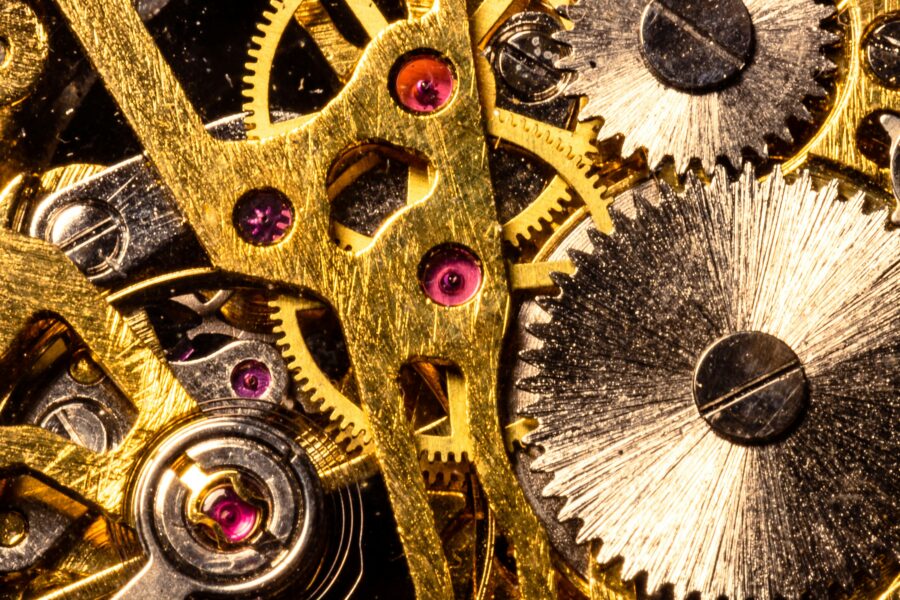
A special investigative report by Aurora Valentine from the Kingdom of Iveninia
It’s my hour to be on watch duty and all I can hear is my heart drumming loudly in my ears. Camped and cramped on a parapet looking west along a dark suburban street, you’d never know that three floors beneath me there is an illegal gathering of the like minded. The clockwork Kingdom of Iveninia calls them time wasters – they call themselves artists.
How did it get to this? Three hundred and nineteen years ago, the ravages of disease, intrigue, and rebellion had left the kingdom with no heir. On the brink of a civil war that could see the kingdom shattered, the King and council commissioned a clockwork prince, to steward the country through the interregnum.
That mechanical monarch still sits upon the throne, a computational placeholder that is one of the longest serving rulers in history. The intent was for Clockwork Prince to sit upon the throne for a few years and keep the country running whilst the flesh & blood claimants figured out through means fair and foul who would take the throne. That never happened and a handful minor nobles still contest they should be the monarch. Few listen to them, as the Clockwork Prince rapidly showed itself to be a highly superior sovereign. “It is the continuity that the folk like,” Sebastian, an accountant, tells me over coffee. Our conversation is hurried, as sitting down to talk is not permitted, so we’re chatting as Sebastian makes his morning commute to his civil service job. “With the Clockwork Prince, we know exactly where we stand – accountable for and measured by our productivity.” For the Clockwork Prince was programmed with a singular goal – maximise the living standards and economy of the kingdom.
My turn on watch has ended, so I’m able to go down into the basement and mingle with the small group there. Tonight’s gathering is a commune of painters, all locals from a town I’m visiting. I can’t say who they are or where I am as I won’t jeopardise their freedom. Snowdrop (everyone here is using aliases) shows me a painting she’s just completed of the landscape outside her window. Primula has an impressionist representation of a dried up river. Forsythia is deep in discussion with Freesia if Caltha’s mecha-dimensional pastel work is actually art if the message is so inscrutable. Each piece would make a fine addition to any art gallery or museum around the world, but must be kept most secret in Iveninia.
The threat to their freedom is very real for the Clockwork Prince has very clear priorities and art does not feature in its calculations. Via a command economy it has organised Iveninia into a country of near full employment with free education, free healthcare, and a complete welfare network. Its subjects want for nearly nothing and in exchange the Clockwork Prince demands efficiency. It understands that a human being can’t work constantly, but it considers any activity that is not obviously productive as wasteful. Even child’s play is measured and prescribed. The price of Iveninia’s wealth has been its culture.
I’m technically here illegally. My visa says I’m here as part of a trade delegation, to talk to local merchants about the nation’s exports. I am doing that. But I’m also here to talk to the people, who even after 300 years, still try to keep Iveninian culture alive. “Yes, the Clockwork Prince has done an amazing job turning our little kingdom into an economic powerhouse.” Forsythia tells me as we sit in a corner next to a secret stash of acrylic paints ” but it has left my soul, and the souls of so many empty. We do our work, we come home, and we’re expected to do what? More training, callisthenics, just sleep? By the sands, there’s even an organised system for going around the neighbours to have a chat. I want to do more than that! I am more than my monthly production targets!”
“Could you imagine what it would be like? Not having everything run so well?” Walke, a spoon merchant exclaims when I ask him about alternative governments. “Iveninia is perfectly fine the way it is. We’ve had only one war in 300 years and that was a minor raid to reclaim territory that was rightfully ours. The Clockwork Prince keeps us utterly safe from almost all danger but bad luck. We have a nationwide meritocracy where every citizen is given a job equal to their means, right from the ministers of departments down to the streetsweepers.” The trade convention we’re chatting at is a mono-chrome affair as every one in Iveninia wears the same state provided clothes – undyed, unisex, and generically sized. Walke shrugs when I mention it “It just makes life easier and more efficient if manufactured goods are standardised for function.” Snowdrop’s floral dress is everything the standard garb isn’t – bright, colourful and fitted. “It was my great-grandmother’s. She had it smuggled in. I only wear it here or at home, in case it wears out.”
Not all agree with such an extremist utilitarian approach and from the start, the Clockwork Prince encountered resistance to them and their technocrats governing not just the country but also mandating nearly every aspect of the people’s lives. The curfews were the first source of protest and the Clockwork Prince’s response to this set the tone. The army was sent in, not with swords, but with handcuffs and rubber truncheons. The Clockwork Prince has calculated that terror and violence are not cost effective and it is not permitted to use death as a solution. “If you’re found to be insufficiently productive, based on your capabilities, even after the government has given you warnings, then you’ll be sent to the labour camps.” Sebastian explains between briefing me on home goods manufacturing in the Regio District. “There the unproductive and malcontents are kept out of the system, much like you would replace a faulty wheel on a cart.”
Caltha tells me more, as her brother has recently returned from a 5 year sentence for graffiti. “If you don’t work at the labour camps, then all you get is the most basic of necessities – a bed, water, gruel. The inmates are monitored constantly and have to sit through hours and hours of re-education training.” She’s amazed her brother came back sane “But he is so quiet now, I miss his laugh.” I hand her a tissue and she shows me a smaller painting that she’s still working on. It’s brutal in its use of blood red and machine steel. “I’m trying to convey how we’ve ceased to become a people and are now just an extension of the machine that sits on the throne.”
It is before curfew, but we have to leave carefully so that we don’t draw unwanted attention. As I depart the illegal gathering of artists, I find myself dwelling on more of what Sebastian said “In the Clockwork Prince, we have a ruler who is uninhibited by emotion. They can make the choices that will ensure minimal suffering and maximum prosperity with the fetters of ego, greed, pride, and petty desires.” I look up at a row of houses that are all identical, each and every one like the one next to it and like all the others in the city. It strikes me as unnatural. Snowdrop is walking with me and notices my unease “Have hope” she encourages “When you look at all this, remember that the human soul still lives beneath it, and art will survive.” I hope it does. For it would be nice to see Iveninia’s gardens once again have flowers.
Image Credit – Photo by Lucas Santos on Unsplash