
Building a dungeon isn’t easy, in fact it’s quite difficult. There’s all sorts of permits you need to get, as folk tend to complain if you start hollowing out the void under your house or digging your way into the side of a mountain. A less bureaucratic and expense method is to have your dungeon as a work of fiction in a table top role playing game. But this approach isn’t as simple as bunging some goblins into a bunch of rooms and calling it a dramatic investigation into the role of wandering heroes into monster socioeconomics.
When I set to dungeon building, I use three headings to guide my thought process.
Challenge
Dungeons need difficulty. They need something for the characters to overcome, a reason why not just anyone with a lantern and a set of lockpicks could come down here and get narrative progression. If you want broad categories, there’s combat, exploration, puzzles, and conversation. Whilst challenges or even encounters aren’t quite the right words for this, the general trend is – interesting things to do.
Combat is fighting. There’s someone or many folk who object to the characters being in the dungeon and have taken up arms to oppose them. When planning a combat scene, think about how the dungeon dwellers might have prepared for intruders – have they set up surprises, do they have a drilled response, how easily will reinforcements come to help them, at what point will they flee or surrender? Setting up a combat starts with getting together the statistics and numbers of the combatants. Balance is important here – you’ll want to think carefully about what the price of victory is going to be. How much harm can this enemy deal to the player characters? Are they going to fight with tactical cohesion? Are they here to slowly drain the character’s resources or is this a fight to the death?
Combats should be compelling, in that they should engage the players, with engagement coming from problem solving and caring about the stakes. Engagement from problem solving builds off of novelty – if the goblins use the same formation and tactics in each encounter, then the engagement will quickly drop off. A good starting point for novelty is how the combat starts. Capable dungeon dwellers will look to use their knowledge of the dungeon and lengthy time to prepare surprises and ambushes. Or it could be the adventurers who start the combat with their opponents unawares. Combat could start with both sides fully prepared for each other, with the adventurers entering a room with prepared defences after failed negotiations.
Exploration is going around the dungeon and learning about its layout. The challenge here is selecting routes that avoid danger, evading detection, discovering secrets, or the quickest way to escape. Exploration challenges work well with dungeons that give the party time and opportunity to plan their approach. How much information are they given about the dungeon ahead of time? How does the story benefit from the characters avoiding some of the challenges? Interesting dungeon layouts are a big part of this, which I’ll talk more about when I talk about choice.
Puzzles are obstacles. These are more than just the traditional intellectual problem of lighting the torches in the right order, placing objects correctly, or answering a riddle. They’re also about how to cross chasms, scale walls, pass doors, or otherwise have to stop moving and think. There’s a recurrent problem here: who’s solving the problem – the player or the character? If the GM has laid out a cunning puzzle for them and then the character succeeds on a skill check, that does seem to take the wind out of GM’s sails. Conversely, the players not being able to solve a problem their characters (with their in universe cultural knowledge) would be capable of, feels like stalling the story for reasons outside of the story. I personally like to set up puzzles and problems that don’t have definitive solutions. If the party comes up with an idea that sounds plausible and they roll accordingly, then they succeed. Not having a fixed solution also enables the party to try something else if the first, second, or seventeenth idea doesn’t pan out. Of course each failure should have some consequences and it is always more interesting to have those consequences extend beyond the door remaining locked.
Conversations are talking. The most basic form of the conversation is the players asking a convenient person where they can find what they want in the dungeon. Probably the convenient person will want something in exchange for the information. The story development comes from expanding on this and playing around with the concept. Is this person a member of the dungeon dwellers and they’re willing to negotiate rather than fight? Are they in charge, harbour ambitions of command, resent their lowly station, or have ulterior motives? If the person is a wanderer, how did they end up in the dungeon and how do they know so much about it? Conversations are a key way for the characters to learn about the dungeon – its layout, its lore, its inhabitants. The mood and emotions of the conversation help set the dungeon’s tone – a desperate prisoner asking for release, a slightly manic dark god worshipper looking for artifacts, the goblin chief seeking a way to protect their clan, or a blood thirsty mercenary committed to revenge. To prepare a conversation, form a clear idea of what the person wants, what limits there are on how they can achieve it, what they have and what they are willing to lose and then sprinkle on some personality quirks.
As with the combat advice, variation and combination is how these combine to tell an interesting story. Populate the dungeon with encounters that are different from each other and try to aim for at least 2 of each category. Think about how the challenges will work together and bleed into each other. How will the conversation go if the adventurers are covered in the blood of those they’ve slain without quarter? Are there more solutions to the puzzle available if the party have explored more of the dungeon? Challenges can be multi-room experiences. The solutions to puzzles aren’t constrained to the location they’re found in – items could be needed from elsewhere in the dungeon to complete a diorama that both reveals the history of the tomb and opens the secret passage to a library. Combat can break out from where it starts if one side seeks escape or reposition. The gnolls could split up in different directions to break up the party and then defeat them in detail.
Treat challenges as opportunities, not walls. They represent ways in which the story can take different paths, not obstructions that stop the story until they are passed. Keep notes and have ideas about what could happen if a challenge is failed. Will the enemy capture them and secure them in a prison? Will they be dumped into an underground river and left to be swept away? Are there clues elsewhere in the dungeon that they can reach to help solve the puzzle? Whilst it can be a drag on the story, there’s nothing wrong with the party leaving the dungeon to get help or equipment to help them pass a challenge – though obviously there should be further challenges awaiting them in pursuit of their ideas.
Choice
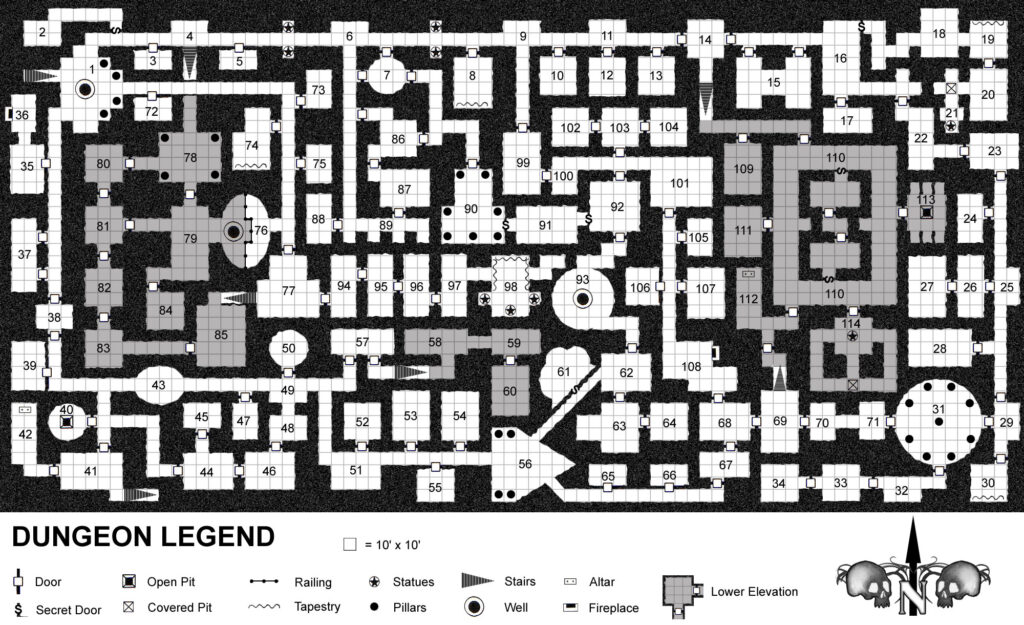
Choice is the order in which the characters do things. In a dungeon this is pretty much the layout of the dungeon. There are broadly four flavours of floor plan – serial, parallel, network, and web. A dungeon could be just one of these floor plans or a mixture with different flavours in different sections. Before going into more detail on the layout options, my starting point is the narrative and logic behind the structure – how is the design affected by its function and its location. A castle is going to be made of up walls and secured gates with large empty spaces between structures. A natural cave will have a branching pattern to it, shaped either by fracture or water. A wizard’s tower will be vertical where a mine will be many sprawling branches. The structure doesn’t need to be always sensible though, as many buildings have sections that are rebuilt, repurposed, or left unused. And the builders may have had aesthetic concerns or a desire for a certain look that triumphed over practicality.
A serial floor plan is one where all the options are presented in a long line. Any side routes are short and don’t lead towards the end of the story. With this layout, you can precisely plan the order of the challenges. I recommend not having too many rooms in a row as it will get boring. A parallel layout is two separate paths that lead to the same destination. Here the party is presented with a clear binary choice – left or right? This choice should matter and so each path should be distinct and contain very different challenges. If the paths are too similar or in the worst case scenario the challenges are set no matter the choice, then that is a linear path. Players will feel grumpy if they spent in and out of character effort on picking their path and that effort was not rewarded or meaningful. Having two distinct paths allows the party to retreat and try the other way if dice and decisions don’t go their way.
Moving away from paths, we have nonlinear layouts. A network is one where some locations link to some other locations, and a web is one where all locations link to all other locations. Both of these layouts give the party the opportunity to avoid or miss challenges and to experience the dungeon in the order they prefer. Networks and webs can be spiced up by adding doors that only open if challenges elsewhere are met. A good example of a network layout is a castle – the central courtyard links together almost all of the locations.
A dungeon isn’t much use to a story if the adventurers can’t get inside it. An excellent way to give the characters an important choice at the beginning of the delve is how they are going to get in. Try to make each entrance different and have each entrance ingress into a different part of the dungeon, so that the choice of approach is meaningful. Options other than the large front gate include an air vent, sky windows, sun columns, rivers, lava tunnels, intruding natural caves, and digging a new entrance. Secrets are an interesting problem – what are they hiding? Is it bonus gold or equipment that is nice to have? Is it critical information? Is it a key part of a long running side plot? My general feeling is to use secrets to hide bonuses. Important story aspects are best left for the characters to find as the whole point of table talk RPGs is to see how the table builds stories and a bit hidden away can’t do that. I’m not a fan of “you must make a perception check to find the door to the next room”. The most common secret is the hidden door but other methods of obfuscations include illusions and fakes.
Charisma
Dungeons need character and descriptions. This is likely the most important bit, as this is where the plans become a fiction.
Let’s start with the big one – lore. And I feel I should make it clear that when I say lore, when I’m running a game what I’m most focused on is how that information affects the story at the table. A detailed history only matters to me if I can make use of it to tell the story. Deep history is interesting but when you tell me why the dungeon is here make it matter. Else keep it brief. Recent history – the last week, the last month, the last year – are the threads that get woven into the adventure in play. If the dungeon used to be an ancient crypt that has now been overtaken by brigand kobolds, how do those two things mix to influence the choices and challenges the dungeon contains. Do the dwarf miners here have old or new grudges with the human village that lives above them? Why are the goblins raiding the city suburbs when their hold contains a huge functional fungus farm? Connect the lore to the dungeon by setting out encounters and challenges that will reveal the lore to the characters – let them find things out piece by piece so you can enjoy watching them enjoy discovering the plot.
The dungeon should have internal logic. Challenges should have a reason for being there. Why is the challenge there? What reason did the dungeon designers or the inhabitants have for setting up this challenge in this room? A fungus puzzle won’t go with a desert temple, fire traps don’t go with ice caves, and a patrol of ogres is incongruous to find in a tomb that’s been buried for a few hundred years. Think about what the objective of the challenge is from the point of view of the dungeon’s logic. Is it there to keep people out? Is it there to test them? Is it an outer patrol or the last stand?
Giving the dungeon a theme is a good way to give it character. This starts with what the dungeon is made of – stone, brick, natural caves, ice, glass, wood, metal, plastic… use this to give quick descriptions of the interior to help your players get thorough feel for that place. How do light and sound travel in here? Is it gloomy, does the light repeatedly reflect, can you hear distant sounds, why is it foggy in here? Theme can be more than physical – are there story ideas and concepts you want to explore with this adventure? You can have the appearance and contents of the dungeon reflect and emphasise these. Do these kobolds have redeeming features and how does this show up in both challenges and descriptions? How is the madness of the wizard apparent from their lair? What messages about death and the afterlife did the ancient elves leave behind in their tombs?
Consider the inhabitants of the dungeon. If they didn’t build the dungeon, why are they here? Does it offer shelter, power, or resources? Are there factions amongst them that the characters can discover, exploit, and learn from? If these are people with needs, how are these needs met in the dungeon? How has their culture and their activities changed the dungeon? The goblins have subdivided the old great hall into private bedrooms. The ogres have blocked off the tiny caves from when the spiders came in. The cultists have desecrated the old gods’ statues.
Thinking about the aesthetic of the dungeon, it’s okay to add rooms that don’t serve the purpose of the dungeon’s story but would make sense to be there. For example, if there are creatures living in the dungeon, they’re going to have somewhere they sleep and somewhere they cook. Even if you don’t have a particular challenge in mind, leave these rooms in to add colour, lore, and logic to the dungeon. Expanding on the form where the denizens are living, think about their schedule. Is there a routine to the guard shifts? How often does the pit monster need feeding? Are there rooms that the inhabitants avoid?
These answers to these many questions won’t build you a perfect dungeon, but they will guide you towards a dungeon that works well as the framework for your stories of adventure.
Image Credits – Dungeon by Jakob Skjerning – CC-BY, Dungeon 68 by Paratime Design CC-BY-NC-SA
